
Why Does Knee Pain Increase in Cold Weather? Ayurvedic Care Tips
MD in Panchakarma | 16+ Years of Experience
Table of Content
Every winter the same thing happens. The first cold mornings arrive, and your knees complain: stiff when you get out of bed, achy on the stairs, sore after sitting for a while. If this sounds familiar, you are far from alone. Ayurveda explained this seasonal pattern centuries ago, and modern research has since found some of the reasons behind it too. Here is why cold weather aggravates knee pain, what you can do about it, and why Ayurveda’s whole-body approach, including Basti treatment, suits this problem so well.
The Ayurvedic View: Why Winter Worsens Knee Pain
In Ayurveda, the body’s movement is governed by Vata, the principle of motion, which is strongest in the joints. Vata is cold, dry, light and rough by nature. Winter has exactly the same qualities: cold air, dry skin, dry wind. When like qualities meet, they build up, so Ayurveda teaches that Vata rises in the cold season, especially in the late autumn and winter months known as Hemanta and Shishira.
The knee is a joint that depends on smooth, well-lubricated movement. Ayurveda describes a natural lubricating quality in each joint that allows it to glide easily. Aggravated Vata dries and roughens this quality, which shows up as stiffness, creaking, pain on movement, and a feeling of the joint “locking up”, the picture Ayurveda calls Sandhigata Vata (joint-related Vata disorder) and, for the knee specifically, Janu Sandhigata Vata. This is why many people find their knees are worst in the morning and in cold weather, and better after warming up.
What Modern Science Says
Modern research does not give one neat answer, but several clues point the same way:
- Cold stiffens tissues. Muscles, ligaments and tendons around the knee tighten in the cold, and the joint is thought to move less smoothly, which can make an already sore knee hurt more
- Weather changes are linked to pain. A study in the American Journal of Medicine found a link between falling air pressure and increased knee pain in people with osteoarthritis, and a large UK study of about 13,000 people with long-term pain found that days with higher humidity, lower air pressure and stronger winds were linked to more joint pain
- We move less in winter. Cold mornings and shorter days mean less walking and more sitting, and joints that don’t move tend to stiffen
- Every knee is different. Not everyone feels the weather in their joints, and researchers say the exact mechanism is still not fully understood
Where the Two Views Meet
It is interesting that the two views describe the same experience in different words. Ayurveda says cold and dryness stiffen and roughen the joint. Modern science observes stiffer tissues, less fluid movement and more sensitivity in the cold. Both lead to the same practical conclusion: keep the knee warm, lubricated, and moving.
Ayurvedic Care for Cold-Weather Knee Pain
Ayurveda does not rely on one medicine. It works on the whole picture: the food you eat, how you live, the herbs you take, treatments applied to the knee, and, where needed, deeper cleansing therapy. This is why it suits seasonal, long-standing joint problems so well.
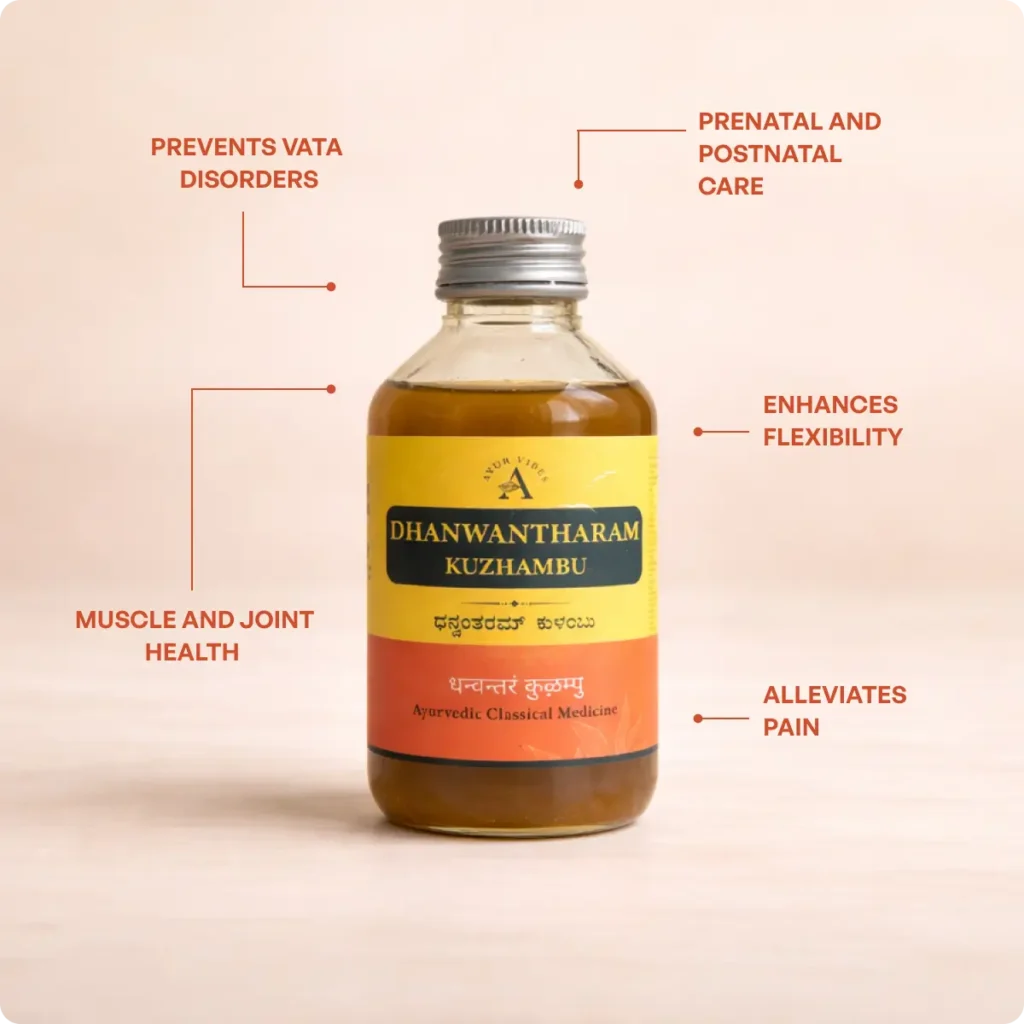
If cold-weather knee stiffness occurs along with broader muscle or bone weakness, AyurvedaOne’s guide on weak bones after 40 gives additional context on bone and muscle support. The joint-care range also includes Dashamoola Kwatha Churna and Dhanwantharam Kuzhambu, which are different traditional preparations. If you are unsure which approach fits your symptoms, book an AyurvedaOne consultation rather than combining several remedies on your own.
1. Warmth and oil
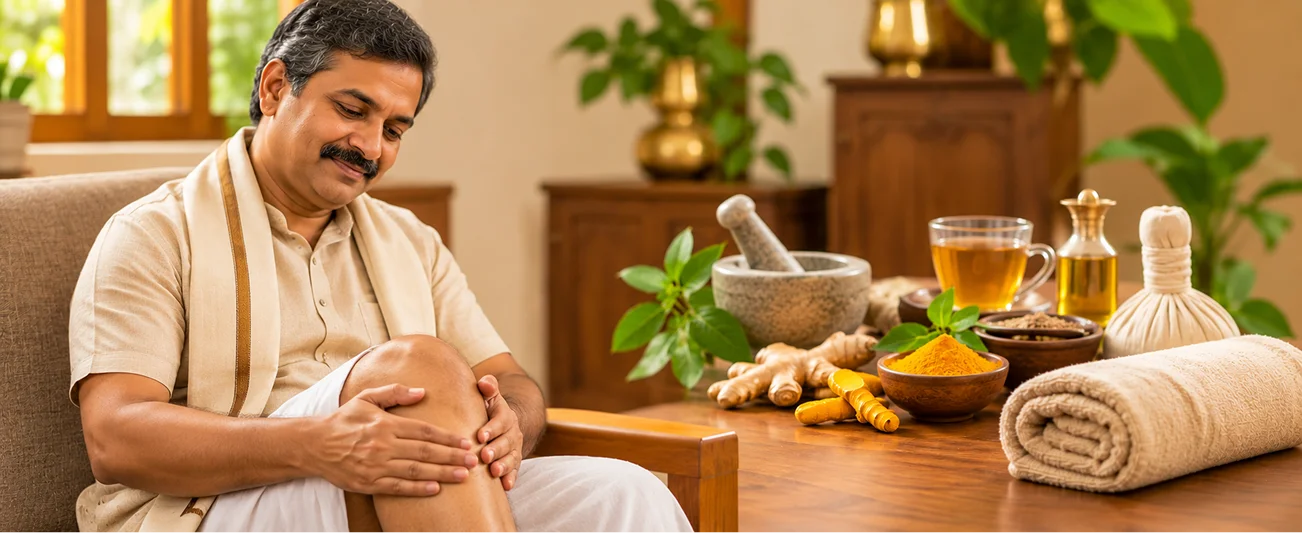
- Massage the knees with warm sesame oil or a medicated oil such as Mahanarayana taila, followed by a warm compress or a hot-water bath. Oil and warmth are the classic Ayurvedic answer to cold and dryness
- Keep your knees covered in cold weather, and avoid sitting directly under fans, AC or cold floors
2. Food that comforts the joints
- Favour warm, freshly cooked, moist food: soups, khichdi, dal, cooked vegetables, and a little ghee
- Use ginger, garlic, turmeric and cumin in cooking, and sip warm water through the day
- Cut back on cold drinks, ice cream, refrigerated and dry packaged food, and heavy fried food
3. Gentle movement every day
- Walk daily, preferably in the late-morning sun, and do gentle yoga and knee-strengthening exercises
- Avoid sitting in one position for long periods, and get up and move every hour
4. Herbs, in tablet form
- Traditional herbs for joint comfort include Guggulu preparations, Shallaki (Boswellia), Rasna, Nirgundi and Ashwagandha. Trials of Boswellia in knee osteoarthritis have reported improvement in pain and stiffness
- Tablets are an easy, consistent way to take them, and your physician can advise which suits you
5. Treatments on the knee
- Janu Basti is a soothing treatment in which warm medicated oil is held in a small well of dough around the knee for a period of time. It is an external treatment, and it should not be confused with the internal Basti described below
- Other options include warm herbal fomentation, Patra Pinda Sweda, and Pichu (oil-soaked cloth)
Basti: Why It Is Considered the Foremost Treatment for Vata
When knee pain keeps returning every winter, Ayurveda looks beyond the knee. Basti is a Panchakarma therapy in which medicated oil or herbal decoction is introduced through the rectum. This may sound unusual, but its logic is simple. In Ayurveda, the lower gut (colon) is regarded as the main seat of Vata. Treating Vata at its root is considered more effective than treating only where the pain appears, and classical texts name Basti as the foremost therapy for Vata disorders. It is so central that some texts call it half of all treatment.
Basti is thought to help by:
- Calming aggravated Vata at its source in the colon
- Nourishing and lubricating the joints from within, since the oil-based preparations are meant to counter dryness and roughness
- Supporting strength in the muscles, nerves and joints
- Cleansing the gut, which Ayurveda connects to overall joint health
There are different types. Anuvasana and Matra Basti use medicated oil, Niruha Basti uses herbal decoctions, and Tiktaksheera Basti, a milk-based preparation with bitter herbs, is traditionally used for bone and joint conditions. Which one is used, and for how many days, is decided by the physician after assessment.
What does the evidence say? Research on Basti in knee osteoarthritis is still small. In a study of 45 people with knee osteoarthritis, those given Tiktaksheera Basti, a Guggulu preparation, or both all improved in pain, stiffness, swelling and function, with the combination giving the greatest relief, and no adverse reactions were reported. It is encouraging, and larger studies are needed. To know whether Basti is suitable for you, consult our Ayurvedic doctors.
Who should have it? Basti is a therapeutic procedure that must be done under a qualified Ayurvedic physician, never at home. It is not suitable for everyone. Pregnancy, fever, diarrhoea, rectal bleeding, severe weakness and some other conditions are usually reasons to avoid it. Your physician will assess you first and prepare your body with oil massage and sweating treatments beforehand. Many people have it in the cooler months, as a course before or during the season when pain flares.
A Simple Winter Plan for Your Knees
- Start warm oil massage and a warm compress every day
- Keep your knees covered and avoid cold food and drinks
- Walk daily and do gentle strengthening exercises
- Eat warm, fresh, moist meals with ginger, garlic and turmeric
- Ask an Ayurvedic physician about joint-supporting tablets
- Consider a Panchakarma course with Basti if pain returns every winter
When to See a Doctor
See a doctor promptly if your knee is hot, red and swollen, especially with fever, if pain follows an injury or a fall, if you cannot put weight on the leg, if the knee locks or gives way, if pain wakes you at night, or if it has lasted more than two to three weeks without improving. These can point to infection, gout, a ligament or cartilage injury, or advanced arthritis that needs proper examination.
Winter does not have to mean aching knees. A warm, well-oiled, moving joint, supported by the right food, herbs and treatments, copes with the cold far better.
Related Products


Secure your child’s immunity with Swarnaprashna
Swarnaprashana blends Swarnabhasma with medhya herbs to protect and empower your child’s health.
Frequently Asked Questions
1. Is knee pain in winter normal?
It is common, especially with age or existing arthritis, but pain that is getting worse each year or limiting daily life deserves a proper check.
2. Can Basti cure knee arthritis?
Basti is used to manage symptoms and support joint function, not to reverse worn-out cartilage. Its benefit is best seen as part of a complete plan.
3. How many sittings are needed?
It is usually given as a course, and the plan depends on your condition. Your physician will decide.
4. Is Janu Basti the same as Basti?
No. Janu Basti is an external oil treatment on the knee. Basti is an internal Panchakarma procedure.
Discover your Ayurvedic balance with our doctor consultations, shop by health concern, or take a quick dosha quiz to find what fits you.
Related Blogs
 Hair
Ayurvedic Hair Care: Best Oils and Remedies for Itchy Scalp
An itchy scalp is one of those problems that is easy to ignore until it isn’t: the constant…
Read More
 Heart Health
What Are Cardorium Plus Uses and Its Benefits?
Cardorium Plus is an Ayurvedic herbal formulation made for cardiovascular support. It combines seven herbs traditionally valued for…
Read More
 General
What Is Abhyanga Massage & Which Oil Is Best for Abhyanga Massage According to Ayurveda?
Abhyanga massage is a traditional Ayurvedic full-body massage with warm oil, applied from the scalp to the soles…
Read More
 General
Vata Dosha in Winter: Symptoms and How to Balance It Naturally
Vata dosha is the Ayurvedic energy of movement, made of air and space. Cold, dry, windy winter weather…
Read More